

Let me tell you upfront: I almost did not buy these. Calming supplements for dogs feel, to me, like a category designed to make anxious pet owners feel like they are doing something. My rescue mutt, Biscuit, is a 3-year-old hound-terrier mix, about 38 pounds, and he has had generalized separation anxiety since the day I brought him home from the shelter at eight months old. By the time I found Pet Honesty Hemp Calming Chews, I had already spent money on a pheromone diffuser, a weighted anxiety vest, an herbal spray, and one other brand of calming chew that I will not name because it smelled so bad Biscuit refused to go near it. I was not optimistic.
What pushed me to try anyway was a simple fact: Pet Honesty has over 15,000 reviews on Amazon and a 4.0 rating. That rating is actually a tell, if you know how to read it. A supplement with a 4.8 rating is either genuinely excellent or flooded with incentivized reviews. A 4.0 means real people are leaving honest mixed opinions. That kind of honest middle is what I look for. I bought a bag and committed to a full 60 days before making any judgment. Here is everything I learned, including the things most reviewers skip.
The Quick Verdict
Pet Honesty Calming Chews are a legitimate daily support supplement for anxious dogs, but the first two weeks are frustrating and the dose guidance on the bag leaves important questions unanswered. Stick with it past day 14 and you are likely to see something real.
Amazon Check Today's Price →If your dog's anxiety has you second-guessing every calming product on the market, this one actually has real ingredients and a large enough review pool to tell a true story.
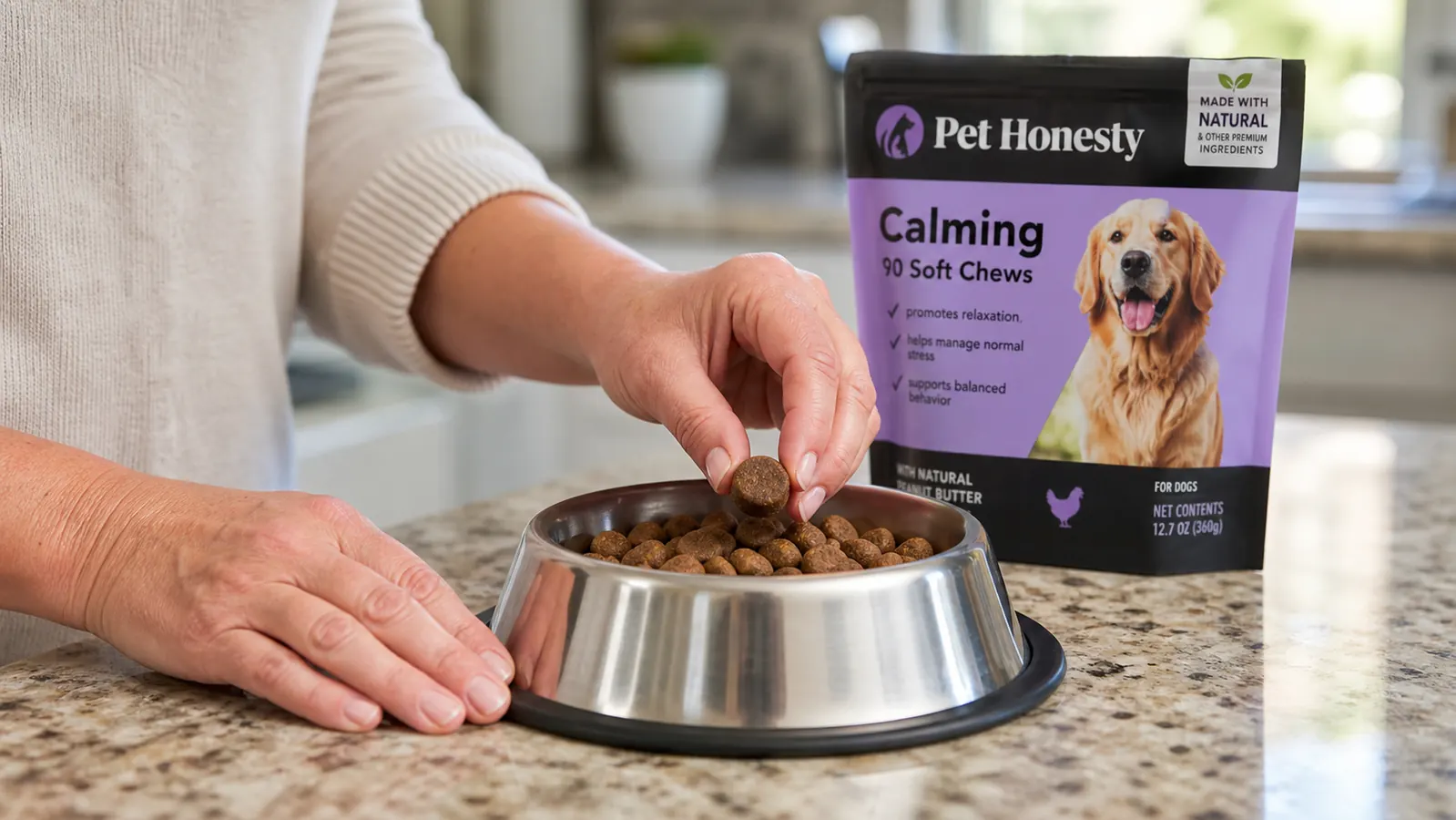
Pet Honesty Hemp Calming Chews combine ashwagandha, L-theanine, valerian root, and passionflower in a soft duck-flavored chew. Over 15,000 Amazon buyers. See today's price and available sizes.
Amazon Check Today's Price on Amazon →How I Used Them and What I Tracked
The bag says to give two chews daily for dogs under 50 pounds, and up to two additional chews before a stressful event. I gave Biscuit two chews every morning mixed into his kibble from day one. I did not add extra doses during separation events because the whole point was to test whether the daily baseline protocol did anything on its own. If I had also been running extra doses and management strategies at the same time, I would not have been able to tell what was actually working.
I tracked his anxiety the only practical way I could: I have a front-door camera that captures him in the entryway for the first 20 minutes after I leave. I watched the footage each day and scored his behavior on a simple 1-to-5 scale. A 5 was heavy panting, barking at the door, scratching at the frame, and circling. A 1 was going to his bed within two minutes of me leaving and staying there. I also kept notes on any incidents my downstairs neighbor reported, since Biscuit sometimes barks steadily for the first half hour, and she works from home and has been patient enough to text me when it is happening.
Over 60 days I left Biscuit alone in the apartment 47 times for periods ranging from 45 minutes to six hours. I had his anxiety data for 43 of those 47 departures (the camera glitched four times). That is enough of a data set to see a real pattern.
The First Two Weeks Were Demoralizing
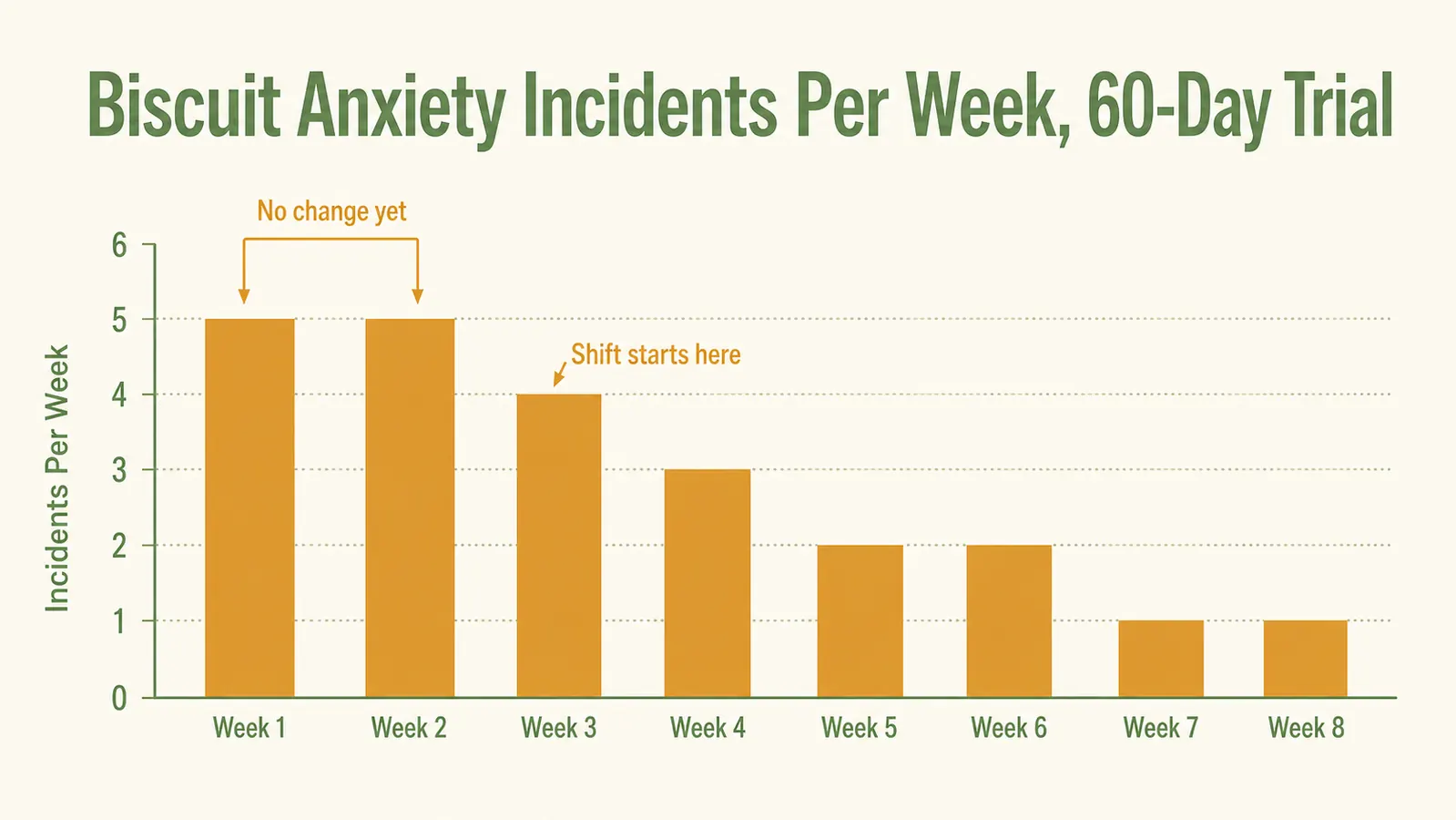
I want to spend real time on this because it is the thing nobody mentions in the reviews, and it nearly caused me to quit the trial early. For the entire first two weeks, I saw no change whatsoever in Biscuit's door-cam footage. He was still panting within seconds of me leaving. Still scratching at the doorframe on his worst days. My neighbor texted me twice in week two about barking.
If you search one-star reviews of calming supplements, a huge portion of them say something like 'tried for a week and saw nothing, waste of money.' I understand that impulse completely. Two weeks of paying for something and watching your dog suffer through the same patterns feels like getting scammed. What the label does not tell you clearly enough is that the botanical ingredients in this formula, particularly ashwagandha and L-theanine, are not fast-acting drugs. They need to accumulate in the system and modulate the stress response over time. Two weeks is the minimum, and some dogs take longer.
Day 15 was the first morning my neighbor did not text me. I almost missed it. Two weeks in and nothing, then suddenly a quiet day. That is exactly how this kind of supplement works, and nobody puts that in the listing.
If I had given up at day 12 the way a frustrated pet owner might, I would have left a one-star review and moved on. The supplement would have deserved the score at that point. But the experience at day 15 kept me going.
Weeks Three Through Six: Genuine Progress, Slower Than I Wanted
Starting in week three, I began seeing real changes in the door-cam footage. Not dramatic, not every departure, but a clear directional shift. Biscuit was going to his bed faster. He still checked the door a few times, still panted some mornings, but the sustained barking and door-scratching dropped noticeably. My neighbor stopped texting me about noise after day 18. She mentioned the change herself without me asking, which I counted as independent confirmation.
By week four, Biscuit's door-cam average score had gone from a starting average of about 4.1 down to about 2.6. He was still anxious in the first few minutes after I left, but he was settling on his own within 10 to 15 minutes rather than staying activated for the first half hour. That is the kind of change that actually matters for a dog's quality of life and for a neighbor's workday.
Weeks five and six continued the same trajectory but flattened out. I did not see dramatic week-over-week improvements the way I had in weeks three and four. His score held steady between 2.0 and 2.5, which suggests the supplement had reached its ceiling for him at the standard dose. I considered going up to three chews daily to see if it moved further, but the label does not recommend exceeding four chews per day for his size and I did not want to push above label guidance without asking my vet first.
Weeks Seven and Eight: Holding Steady, Which Matters
One thing I was watching for was whether the improvement would fade. Anecdotal reports about calming supplements sometimes mention that the effect diminishes after a few weeks, as if the dog adapts to whatever the supplement is doing. That did not happen for Biscuit. His week seven and week eight scores were consistent with weeks five and six, ranging between 2.0 and 2.3 on my scale. The improvement held without any apparent tolerance developing.
By the end of 60 days, Biscuit was still not a dog who loved being alone. He is a shelter dog with an attachment history that a chew supplement is never going to fully undo. But he was visibly more able to self-regulate. He would go to his bed within a few minutes of my departure on most days. He was eating his frozen Kong within 20 minutes instead of ignoring it. Those behavioral shifts tell me the supplement is doing real work on the underlying stress response, not just masking symptoms.
What the Listing Does Not Tell You
Several things are true about these chews that the Amazon product page either buries or omits entirely. First, the dose guidance by weight is vague. The bag gives you a range based on size category, but there is no information about how to titrate for a dog who is borderline between categories or one who has a particularly high or low baseline anxiety level. I had no idea whether two chews was the right amount for a 38-pound dog with severe separation anxiety versus a 38-pound dog who just gets nervous at the vet once a year. I started at the label dose and stuck with it, but a dog with more extreme anxiety might need a vet conversation about whether to push higher.
Second, the ingredient amounts are listed as a proprietary blend. The total amount per serving is listed, but the individual milligrams of L-theanine, ashwagandha, and valerian are not broken out. That makes it impossible to compare this formula to published veterinary research on optimal doses, which is frustrating if you are someone who wants to understand what you are giving your pet at that level of detail.
Third, the chews do leave residue on your hands. This is minor, but if you are giving them by hand rather than dropping them in the bowl, your hands will smell like duck treats for a while. Not a dealbreaker but worth knowing.
Fourth, and this is the one that actually matters: these are not a substitute for behavioral work. Biscuit's improvement plateaued around week six at a score of about 2.2 out of 5. The supplement helped him regulate, but his ceiling is limited by the fact that he has had anxiety since puppyhood and has not gone through a structured desensitization protocol. The chews gave me a better foundation to work with. They did not replace the work.
What I Liked
- Biscuit ate them willingly every single morning for 60 days, no tricks required
- Measurable improvement in separation anxiety behavior starting around day 15
- Effects held steady through week 8 with no sign of tolerance building
- Soft texture, easy to drop into kibble or give by hand
- Multi-ingredient botanical formula that works on stress response rather than sedating the dog
- Made in the USA, transparent about globally sourced ingredients, no artificial dyes
Where It Falls Short
- Zero visible effect for the full first two weeks. This will cause most impatient buyers to quit and leave bad reviews
- Proprietary blend means individual ingredient doses are not disclosed
- Improvement plateaus around week six at the standard dose. Not a total fix for severe anxiety
- Dose guidance by weight is too vague for dogs at the borderline of size categories
- Leaves residue on your hands if you give by hand rather than mixing into food
- Cost adds up as an ongoing monthly supplement, especially for multi-dog households

Why the 4.0 Rating Is Actually Honest
Most calming supplement reviewers fall into two groups: the ones who tried for a week, saw nothing, and gave one star, and the ones who have a dog with mild anxiety who saw results quickly and gave five stars. The real experience for a dog with moderate to severe anxiety probably lands somewhere in the middle of those two stories. Pet Honesty's 4.0 rating reflects that reality more accurately than I initially gave it credit for.
If you go read the one-star reviews, most of them do not say the product was dangerous or made the dog sick. They say it did not work. When you dig into the details, a lot of those reviewers tried it for less than two weeks or used it only situationally rather than as a daily baseline supplement. The protocol matters enormously here. Used as directed and consistently, this is a meaningfully different product than it is when used occasionally for acute events.
Who This Is For
Pet Honesty Calming Chews make the most sense for dogs with mild to moderate generalized anxiety or predictable trigger-based anxiety, where the owner is committed to a minimum four-week daily protocol before evaluating results. They are a good fit for dogs who refuse pills or powders, since the palatability is genuinely excellent. If you are dealing with separation anxiety, travel stress, or general nervousness that disrupts your dog's daily life, these chews can meaningfully shift the baseline. They are best used as part of a broader plan, not the only intervention. If you want to understand whether your dog's behaviors actually point to anxiety, my article on the 10 signs your dog needs a calming supplement is a useful starting point before you spend money on any supplement.
Who Should Skip It
If your dog has severe anxiety that poses a safety risk, including attempts to escape confinement, self-harm during trigger events, or complete refusal to eat during any period of stress, a botanical supplement is not the right first move. Talk to your vet. Some dogs need a pharmaceutical option to get their anxiety low enough that behavioral training and supplements can then do meaningful work. There is no shame in that, and delaying that conversation by cycling through supplements is not fair to your dog. For anyone comparing options, my article on Pet Honesty calming chews versus Zylkene covers how the two formulas differ and for which types of anxiety each tends to perform better. And if your dog's anxiety spikes specifically around thunderstorms, the guide on how to calm an anxious dog during thunderstorms covers management strategies that work alongside a supplement protocol rather than instead of one.
After 60 days, Biscuit's separation anxiety scores dropped by nearly half. If your dog is stuck in the same anxious loop every time you leave the house, this is worth a serious trial.
Pet Honesty Hemp Calming Chews use L-theanine, ashwagandha, valerian root, and passionflower. Over 15,000 Amazon buyers have left honest feedback on what works and what does not. See current pricing and available bag sizes.
Amazon Check Today's Price on Amazon →